

What a Vietnam Cobra Pilot Can Teach Us About Attention
And knowing what we choose to live for

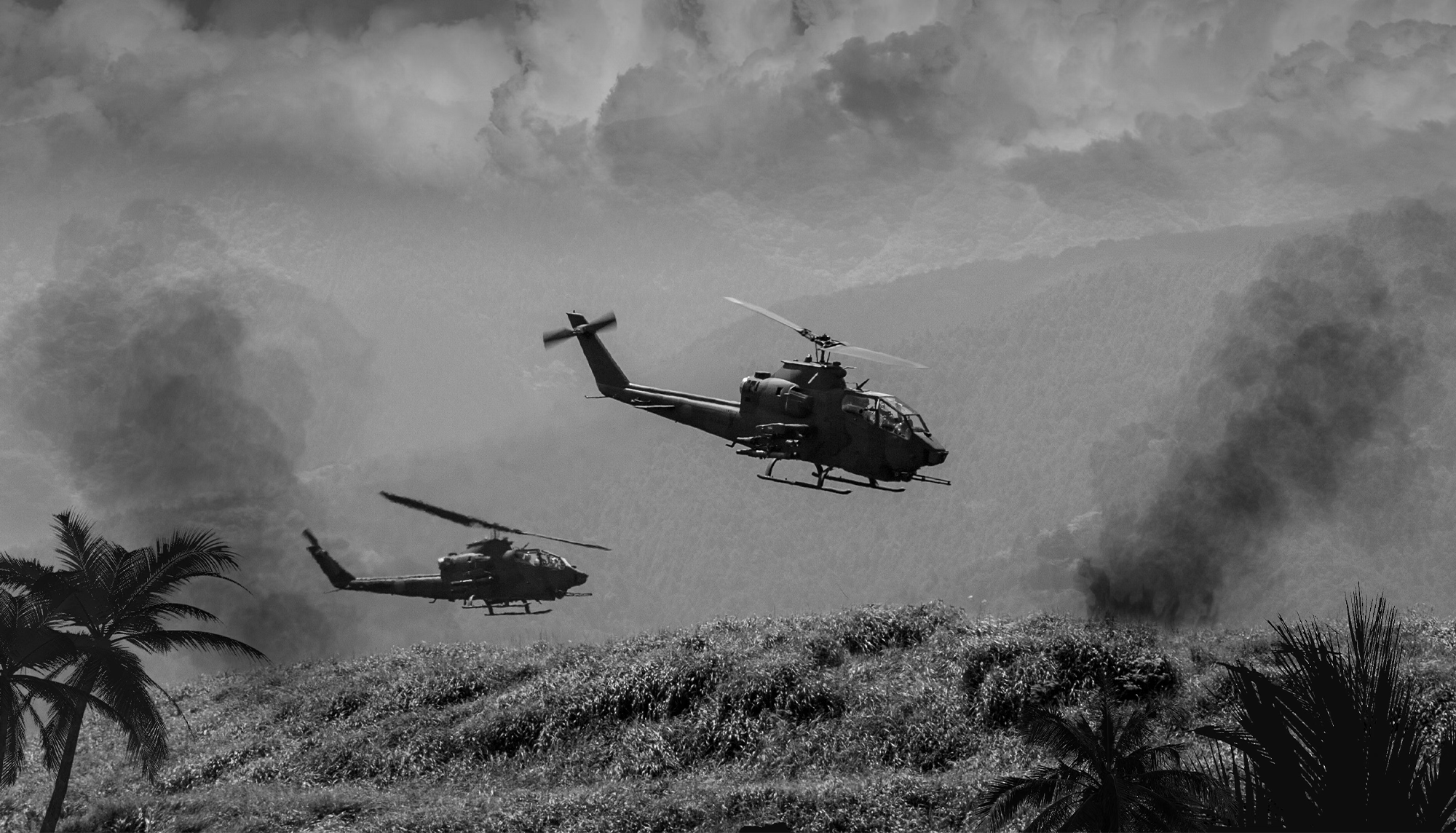
I recently talked to one of my subscribers who chose to enlist during the Vietnam War. He enlisted believing he would earn a commission so that he could fly in combat as a helicopter pilot. This he did, and no, this is not easy. He completed three tours to Vietnam and had his helicopter shot out from beneath him each time. Men like this will live an entire lifetime without saying a single word about what they have done and seen. I am therefore honored to write about one of his missions, and the lesson that can be drawn on the human condition—a lesson that fits within the What then? universe and where this project is heading.1
On 12 January 1971, a team of Cobra gunship helicopter pilots traded jokes over their radios while flying above the jungle. One of them was Marshall R Peterson. His mission was to escort twelve Huey transport helicopters flying in formation.
Suddenly, the word “fire” was passed over the radios in rapid speech and the jokes came to an end. Green tracer rounds fired from .51 caliber machine guns lit up the sky like “luminous green basketballs.” A Huey was hit and spiraled in a swirl of black smoke into the blue-green jungle below.
It is here Marshall writes, “Now I have to devote my entire attention to destroying the machine guns that are harvesting the helpless and frantic formation.” He rolls his gunship into a steep dive and flies straight at the machine gun spitting half-inch metal bullets at him at 2,910 feet per second. He arms his gunship and lines his green reticle up with the source of the green tracers. His gunship starts shaking from the speed. He squeezes the trigger and shoots two rockets at the machine gun crew who look up at him in his metal ship. In slow motion, they swivel the barrel of the .51 caliber gun and point it at him. Marshall’s first two rockets miss, and he uses slight pressure on the tail rotor petals to walk the rockets up the hillside one by one until the machine gun crew vanishes in a cloud of dirt, sweat, leaves, smoke, and metal.
A mass of enemy machine guns in the battle zone start targeting Marshall’s dangerously low flying Cobra. Bullets shatter the glass of his gunship. Bullets hit his copilot. Finally, bullets kill his engine.
Marshall prepares to crash land as the jungle grows closer.
And then silence.
For my part, the most significant moment of his story was the line: “Devote my entire attention.” It immediately hooked in my mind. Attention means applying our mind to something. Its original meaning was to stretch toward something.
What, then, was Marshall’s entire attention devoted to?
A machine gun shooting at his men.
Very good.
But what kind of attention was it?
Mortal attention.
Mortal attention is a response to a mortal environment: bullets, punji-pits, a mamba in our boot, swirling bits of jellified napalm. Mortal attention is our natural response to life-or-death situations. It has a way of waking us up. It forces us to define what we are willing to die for, and therefore what we are willing to live for. The great things, such as the humans and dogs we love. The small things, such as the multi-colored striations in an iris, stopping and listening to the songs of the cicadas as solemnly as if they were the songs of the gods, deciding to train, sweat, fail, and fight again and again until we learn to love the fight and it becomes our identity. It is not always pleasant, but it is what makes a life epic.
So we find mortal attention in mortal environments, and it is the maximum expression of what sort of animal we are and how it is possible live.
And it is this exact mortal attention we do not find often enough in non-mortal environments.
It is in peace we witness a non-mortal attention. A lack of mortal attention for the Milky Way splashed across the black arc of sky above; a lack of mortal attention for closing our eyes and savoring the taste of a fig, a wafer of pure cacao, a slab of london broil, as if each were our last meal, our last taste; all those little things that are of mortal importance but that do not appear to be so in our non-mortal world. But it also applies to the great things: a lack of mortal attention for our bipeds and our quadrupeds, a moment of devoted attention without a single liquid crystal display in sight.
This is a clash between two contradictory ideologies: between anthropological truths and intellectual beliefs.
It is clear if we were not designed to pay mortal attention to mortal dangers we would not be here. For where are our shells? Where are our claws, scales, fangs, poison, horns? What with our soft skin and our dainty teeth and our pretty eyes, we would have been gone extinct three million years ago.
We lack these things because we are neither prey nor merely predators—we are cognitive predators. We are wired to devote our attention to red savages painted black with tomahawks in the stone age and to black skies painted red with rockets in the digital age. Our mortal attention demands that we define our values and train for them long before those we care for are shot at by .51 machine guns. It is to relentlessly live on the offensive.
But we at present can live without paying mortal attention because anthropological truths no longer remind us we are mortal—and intellectual beliefs have filled the void. These intellectual illusions come in a stunning variety: one is that merely making it to eighty is what matters no matter how little living happens on the way there; another is that reality must meet our overly inflated expectations or “life sucks”; yet another is that minor problems and insults are as deadly as a holocaust and that our freedoms must be censored, ironically enough, unpeacefully.
It is a quintessentially human self-contradiction: countless brave men and women died for peace, only for those in peace to fall asleep and forget why peace is nice to have in the first place.
So more peace leads to more drift—but only up to an inflection point. What then is this inflection point?
The point at which those in peace choose to live with mortal attention in a non-mortal world.
To be free from bullets, napalm, and crashing helicopters, and yet choose to live with mortal attention as a discipline, a way of life, a passion project.
There are a few worthy questions we might ask ourselves throughout the day. If X is not worth my mortal attention, why am I doing it in the first place? If X is not worth my mortal attention and I continue to do it anyway, what does this say about me? And if I know X is worth my mortal attention but I do not give it, what does this make me?
Mortal attention demands we define ahead of time what we are willing to die for, and thus what we are willing to live for. So if we know what X is, and X is worth our mortal attention, why not stretch towards it as if today were the last day we ever get to pay attention to it ever again? To our mutts, our children, our friends, our books, our professions, our silent contemplation, our hill sprints, our Milky Way, our inhales, our exhales?
If you enjoyed this, please consider adding a like, restacking this essay, leaving a comment, and sharing it with others.
This is how more readers find my work.
Post script: Marshall finished his story with one last gem. As he was in the middle of his fiery fall from the heavens, his helicopter rotors were screaming, and his hull was rattling, he said all he could do was “accept what fate had tossed me.” He accepted sensory overload from blue sky to black forest on his crash landing. He accepted his bleary reorientation in the ruined cockpit. And he accepted the sounds of enemy voices nearing his wreckage. When we live with mortal attention, what is left but to fully accept what fate has given us, knowing we left nothing on the table?


Sam, I served with a lot of those Cobra pilots. They were Majors and Lt. Colonels, by the time I ran into them, HMLA 269 “The Gun Runners” were stationed at MCAS New River, when I was next door at Camp Geiger, I am in touch regularly with the CO of the squadron which he commanded circa 1979-81. They were a different breed! Friday night at the New River O Club often went from nearly crazy to full on crazy. They were wild. They suffered three noncombatant losses while I was there, and then the new CO showed up. He had flown UH-34’s and UH-1’s on his first tour and then converted to A4’s for his second tour, in Vietnam. By the time he picked up HMLA 269, they had lost their discipline and perhaps their “mortal attention.” He brought them back to reality, as if losing 3 birds and 6 comrades wasn’t enough. Back to basics and flying by the book, (he was no stranger to flying by the seat of his pants, but they needed to recover that which was lost, have to start somewhere)
In much of your posts you remind the readers of the fragility in which we endeavor to live our lives. Yet, we go about our days as if we are Pelle the Conqueror, without the tragedy of being Pelle. The cars have too much horsepower, and are built so well that they survive high speed crashes, smashed to the size of a go kart, the driver and passengers emerge from the wreck virtually unscathed. No lesson learned, and they have no sense of fear. But then they fear their very existence, “what if I get a common cold, what if someone says something “mean” to me,” you mean like you’re over weight and are going to develop diabetes, if you don’t put the barrel sized container of Cheetos down…The horror. Today it is chilly here 1 degree Fahrenheit, we might make it all the way to 20, but the sun is blazing as it is rising, while there won’t any need for mortal attention as such, 30 minutes out in the clear cold will remind the writer that we are only a warm down jacket and lined trousers away from freezing to death. Life is precarious in that way in the times we live in. Not so? Maybe we should find time to consider making a point in the day every day to consider something that requires our “Mortal Attention.” Hmm, that sounds very hard and scary!! Maybe just recognize that being up and taking nourishment, looking around your tactical area of responsibility, (TOAR) and using situational awareness will do!
Great post! As always you got my brain engaged early….
Going to be thinking about this one for a while:
“The point at which those in peace choose to live with mortal attention in a non-mortal world.”