

Why We Grow From Pain, Loss, and Cutting Away
SEAL training, autoimmunity, figs, and temples

SEAL. Writer. Dispatches on meaning, myth, training, figs, dogs: nature and human nature.
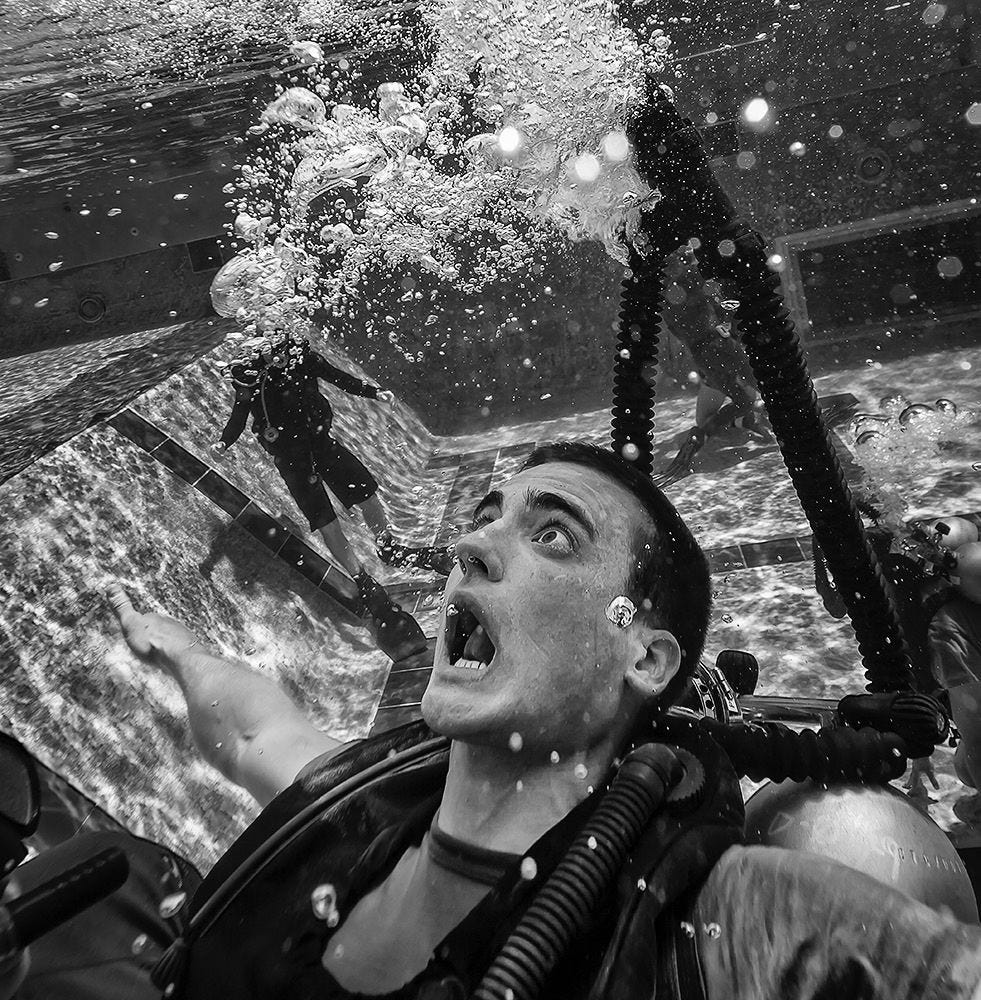

Fig wisdom—Growth is not defined as the absence of pain. And yet we do not find the word “pain” in official dictionaries. Instead, we see “progressive development.” It is a paradox that progressive development for both figs and humans demands both pain and loss: undertaken by choice, as a discipline.
My fig trees grow like man-eating Jurassic plants during the summer months. Malachite green leaves stretch for the sun and soak up its radiant energy, only to turn into leafless steel-gray skeletons in the fall. The actual fruit of the fig only grows on current years new branch growth—not last year’s branches. New fruit sites require new nodes. So, when winter comes, I have to saw several feet of branches off of each tree until I am left with a mangled stump. I feel like I am going backwards, as if I am causing the tree pain. But it is only through this loss and this pain—this cutting away—that growth happens.
Thus the fruit of the fig is born.
It struck me as I was sawing off the branches this is in fact a crucial human problem. What, then, is the significance of this “cutting away” versus its opposite tendency, “holding on,” when it comes to our growth?
The healthiness of illness—Autoimmunity is a good example of ill health as a whole. This is when our immune system attacks itself in a confused attempt to save us, threatening our lives in order to save them. It is madness. My immune system decided to go insane after my last tour overseas and it began to believe normal foods were infectious diseases. At the time I was obsessed with espresso. I loved the sharp Arabian twang assaulting my nostrils every time I boiled a pot over a fire or, when home, opening the door of a cafe in the morning. Until suddenly not only the espresso itself but even the scent could cause an immune reaction. I could not believe my body was no longer under the command of my mind. I issued orders but it no longer obeyed. When it came down to the choice between a pill and a path I knew no one to have walked, I decided to walk the latter: I cut out coffee, and then I cut out every other liquid, solid, and vapor my body reacted to.
I learned many of the modern world’s luxuries, in many cases, are actually poisonous: alcohol, sugar, emulsifiers, flavorings, antibiotic infused meat, chemicals, seed oils, household cleaners, the list goes on. I ate less a dozen foods for several years until I finally stabilized. I still eat a spartan diet and I would have it no other way. Like my fig trees, I reclaimed my life not with addition, but with the pain of subtraction, of cutting away.
Life is pain. To live is to choose that pain. Therefore each day becomes an arena of introspection and adventure. Each is to view the body of flesh and blood as an array of forward operating bases, each, in the end, expendable in the war effort, and the mind as the command center. When the war is brought to our doorstep we see the inversion of the belief the body is primary—the mind becomes all.
I have found that by cutting away it is easier to get lost in the taste of the cold juice filled vesicles of a sumo citrus and the sight of its cottony veins of pith, a glass of ice water after a humid walk in the woods, a strawberry gently twisted off the vine. The harmful patterns of a life are revealed with this way of seeing, and with it the divinity within the patterns of our own construction is made possible.
Healthy catastrophizing is an art form—The most important possessions to pre-state peoples were related to weapons and art. A mobile life made it so that they could only own as much as they could carry on their backs. For war and hunting they carried a spear, an atlatl, a sling, a bow, and a blade. For art and mythology they carried charcoal, paint, songs, stories, and an awareness of god-in-everything.
The necessities of modernity are only necessary in modernity. Remove modernity, and suddenly a bone-handled blade, a bit of finger paint for drawing on cave walls, a djembe drum—suddenly these simple concretes are worth far more than a BMW or a trip to Mykonos or a 401K. For what are these modern necessities worth if the electric grid is sabotaged and the food chain comes to a halt? It is a fateful irony that if modernity crumbles the human is rendered essentially un-human without an intimate knowledge of our analog heritage—unprepared for the worst case scenario, which is actually the normal scenario.
Aeschylus said “Wealth is useless to the dead.” It becomes clear that cutting away is a mortal practice. It is too live as if it were 30,000 years ago. It is to catastrophize the worst case scenario and thus find meaning in a far more simple mode of life, in the raw power of hand and mind to build, create, and prepare. Healthy catastrophizing leads to a minimization of the luxuries of the present and a maximization of the necessities of the past. With this mode of mind, the wonders of the present are suddenly worthy of profound gratitude as opposed to stepping stones to unattainable expectations.
Inner temple—The root of the word “temple” means “to cut” or “to divide”. Put together, it means to create a structure and close it off to everything else in life: farms, labor, house, forests, technology, work, entertainment, fame, craving, aversion. On the one hand, it is an irony that in cutting off a sacred place from all else we concretize the separation between worship and the rest of our lives. Worship happens over there, and miserable daily grind happens right here.The split becomes normalized. On the other hand, we now have access to a space which provides a counterpoint to everything thought of as miserable.
The temple comes in many forms: the church, gym, orchard, dojo, shooting range, copse of woods, steep gravel hill with a kettlebell, garden, pond, writing desk, stone ringed fire. Each is a space all its own, and yet its meaning can be carried within like body armor for the soul, a mobile sacred space of the mind, a conscious kitting up for all the major and minor trials in a day. The contrast is crucial because it makes it possible to concretize the temple within.
A mode of mind worth habitualizing—Cutting away can hurt. But sure enough, there are many ways of stepping outside of this pain, holding it in our hands, and taking the ontological high ground. This is one example.
A striking part of SEAL selection is the dive phase. In it, a candidate must demonstrate his ability to remain calm fifteen feet underwater as several instructors tie his breathing hoses in a knot, flip him around, rip his mask off—and then drift back a few feet and silently watch him. How will he react? If he fails to untie the knot and shoots for the surface, he fails the test. If he blacks out, he earns a bit of respect for his self-discipline, but he still fails, and either does it again without losing consciousness or he leaves the program. It is quite stressful.
And yet the second he breeches the surface with barely enough oxygen to remain conscious, he can still fail even if he does everything else right, unless he remembers to say three words: “I feel fine.”
Of course he does not feel fine. He feels like he is dying. His ancient body made of cells and neurons adapted to five million years of life-and-death scenarios naturally panics at the prospect of death-by-drowning. It hijacks his inner discourse. It makes him hyperventilate. It turns him into an animal. And in this way he has the chance to become a bit more human—by cutting away.
What, then, is cutting away? What is pain? What is loss? What else but an opportunity to say “I feel fine?”


Sam, this is good and very relatable. By coincidence, our community farm has fig trees and I see our volunteer fig keeper doing the cutting just like you described. On top of it, he is x West Pointer; military doing the cutting!? I’m supposed to do pruning the bottom tomato suckers and I feel bad doing that. It pushes the energy to the top for bigger fruit. Again, Mother Nature is teaching us how to live. How much do we really need.
This was a good perspective change for me! And also a validating read, because sometimes when I spend too much time around some people in my life I feel like I am crazy or weird for catastrophizing, contemplating the end of the world or simply weird shit happening. I see it in a similar way as the Stoics described "Premeditatio Malorum", let them come, I'll be ready!
And lastly, it's interesting to think about mindset shifts and perspectives regarding this single phrase of "I feel fine", because for some people it's automatically denial which will lead to a downward spiral and a crash, but for others it's empowering, or at least a method of clinging to agency.