

Why We Should Listen to the Voice of Dog
How our mutts make us (more) human

SEAL. Writer. Dispatches on meaning, myth, training, figs, dogs: nature and human nature.
Welcome back.
The theme today…
dogs.

Let us travel back in time—“I am in tears, while carrying you to your last rest place as much as I rejoiced when bringing you home in my own hands fifteen years ago.”
We can see the Roman who spoke these words thousands of years ago. He is standing before the tomb of stone he built for his mutt. We can stand beside him in his skull and watch his memory of fifteen years prior: he is walking home on a dusty road wearing leather sandals. A bright-eyed puppy is pawing at his shoulder in uncontrollable happiness at being alive. The contrast between the tears streaming down his actual face and the smile on his memory’s face is as striking as the contrast between the flailing puppy in his arms and the grey-bearded corpse lying still and silent in its tomb of stone.
There exists a difference between when the dog is at our side and when the dog is not at our side. Every single day I am reminded this difference—and thus the dog—can teach us what it means to be better humans.
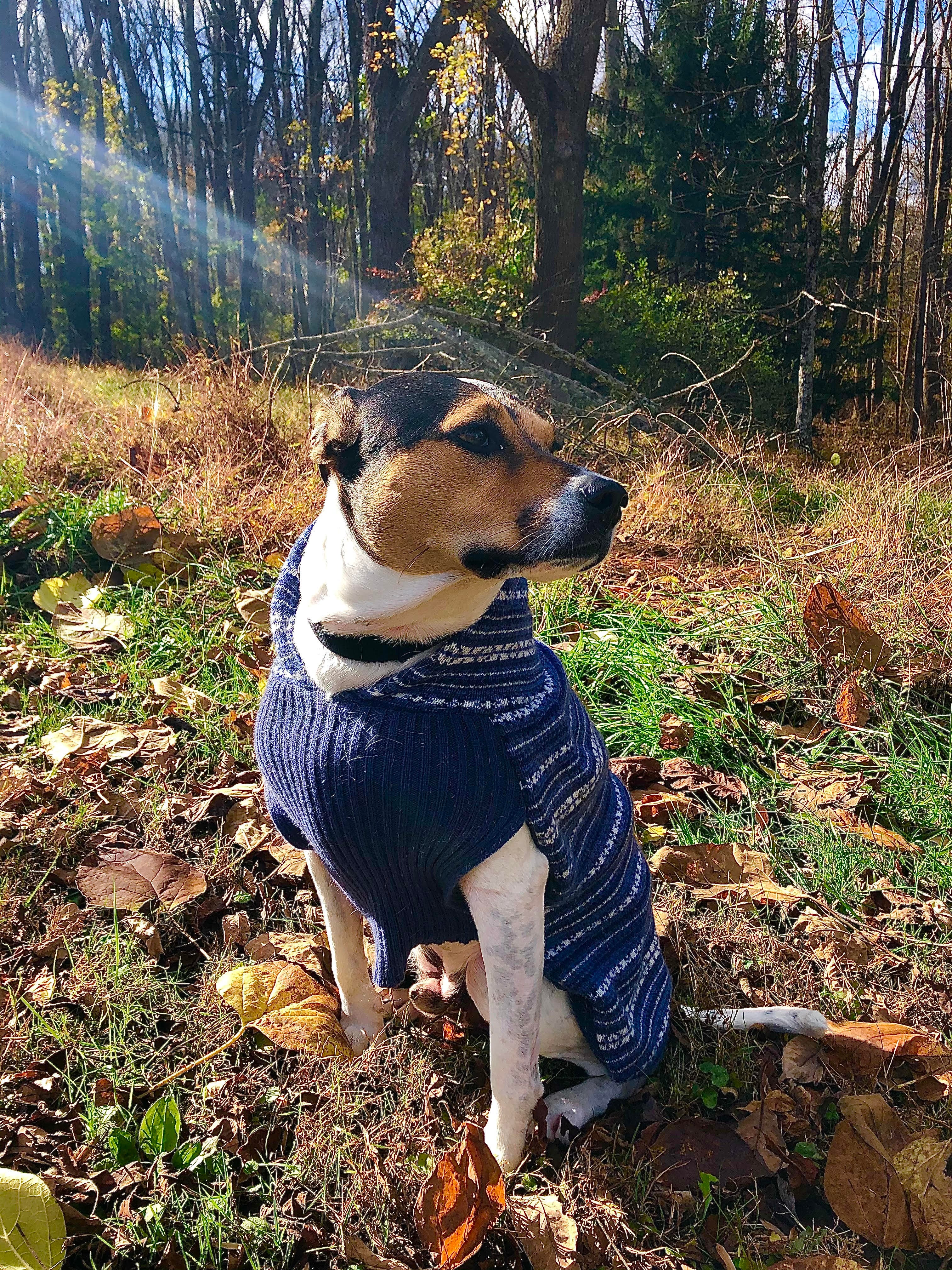
Primeval kin—Carson’s fur is milk-white and interspersed with small black and cashew-colored freckles. And yet his superhero mask of caramel and jet black means when he faces me in the woods he is nearly invisible while wearing his genetic camouflage. A truly tactical specimen. But when he turns and runs away from me his furry white ass assaults the space of the forest like a rupture, a disorder—a rebellious assertion of life. He sprints through the pickers and the ferns with an ear to ear grin. He is a friendly moon orbiting my position, emitting an incandescent light that obliterates the shadows, a furry and flashing white tube low crawling and jumping and juking. Trees and ferns are alive, yes, but nothing alive compares to the life force of a human with a dog. He is a reminder of the fight we and our mutts have endured, side by side, for millennia in a cosmos that gives us life and then constantly tries to take it away.
On the one hand, the primeval world is inhuman and wants to kill us. The woods without a dog at our side are beautiful. And yet after long enough time, they can become chillingly empty. Even walking with other humans in the wild has a different texture than walking with a dog. On the other hand, the primeval world is the antidote to the speed and sterility of modernity. It adds much needed simplicity by bringing meaning closer to the surface, so close we can feel it in our bones and our lungs. It feels like a warm ball of gratitude in my gut. My sense is the dog is a bridge between us and the primeval world. The dog, then, is an oracle whose wisdom is from an era whose language we no longer speak.
This emptiness is even more pronounced in modern environments without moss, hawks, rivers, stars, and fig trees. What is a metal car without a mutt’s head sticking out of the window and whose black lips are flapping in the wind? What is a silent kitchen without the click click click of nails on oak floor boards? What is a quiet room at night without the snoring of a dog dreaming savage dreams whose lips and eyelids are twitching, whose little hooves are clenching, and whose whimpers make us want to bear their pain?
Our dogs remind us civilization is a thin coating on top of a deeper and more ancient reality, a more ancient truth as to what it means to be human. In this way they are stewards of our humanity.
Conversation with a dog—Sometimes the best conversationalists are those who know how not to say a single word. My best thinking is done while walking or with Carson—and walking with Carson is to witness an explosion of ideas and connections within my skull, and awe for every oak leaf and cirrus cloud that lies outside of it.
He does not knit his brow and look to the left or right, waiting to get his word in to prove how intellectually superior he is. He does not indicate with raised eyebrows he is on a tight timeline and has more important matters to attend to. I can play with new ideas. Ask questions. Make an absolute fool of myself. Admit when I feel like the world’s greatest fuck up. We can talk about current events, highly charged political issues, the most tortured dreams and fears from the chambers of my subconscious—literally anything. I can sense his patient acceptance, and without any effort on my part, I can feel myself giving in to full freedom of thought and expression.
Conversations with a human can change our lives forever. At the same time, I sometimes feel like I would rather be water-boarded by Al Qaeda than deal with one more person who only knows how to speak in monologues.
With a dog, dialogues and monologues are no longer displays of knowledge but paths to wisdom. With a dog, we learn how to listen. With a dog, conversation can only ever be one thing—a reminder our life is an adventure, an experiment, a poem forever only halfway written.
Why reduce when we can reveal?—I always find it striking the universe, phones, places, events, children, dogs, eyes, ourselves—each can be reduced to mere atoms and cells if all we do is look at them. Meaninglessness is easy to find in a world without the constant threat of death. And yet each of these gatherings of atoms and cells is an explosive source of meaning, if we consciously choose to see them.
Yes, the dog is a mass of meat and fur. But if I stop what I am doing, reach out my hand, and hold Carson’s snout so we are eye to eye, I sense a detonation of compassion arise between us—I sense meaning. The pink skin of his armpits—meaning. The logarithmic spirals in his coat that obey the law of the shell of a snail or the arms of a galaxy—meaning. When I scream there is meat in his bowl and he trots out of the bedroom with the “All of this… for me?” look on his face—meaning.
One of the strangest aspects of modernity is the belief we must “create” meaning as if it were an app. Close inspection of both our bipedal ancestors and our quadrupedal mutts is that meaning is not created but revealed. It simply waits to be seen—and the dog can teach us how to see.
The Voice of Dog—Our Roman looked fifteen years into his past and mourned the loss of his dog. What then? We can look at our Roman and his pain thousands of years in the past—and what then? The dogs teaching is so profound because it reminds us time is a law we do not get to write. The dog reintroduces us to the value of time. Our dogs will be memories soon enough, and they remind us with their short life spans we too will be memories—us and everyone we care for.
If I stop and stare in Carson’s copper-colored eyes, I hear his voice inside of my skull with his pure, primeval, simple ultimatums:
Do you choose to learn what it means to be human from a dog, or not?
Do you choose to remember accomplishment is useless unless it makes you useful to others, or not?
Do you choose to learn the compassion of silence, or not?
Do you choose to scream every now and then, for the sheer thrill of it, as a form of play and to make of life an adventure, or not?
Do you choose to walk in the woods and celebrate the spectacle, the simplicity, and the fight of every epic day you get to live, or do you not?


Animals are life
What a cutie in that picture! The bond between a human and a dog is spiritual, I often have the sense my dog has the ability to communicate straight to something deeper in me. She never fails to bring a smile. And there’s a quiet sense of safety in her presence alone, something steady and unspoken. just looking at that soft bundle is enough to create a sense of home. It really is a privilege to care for these gentle, loyal creatures.
Beautifully written!