

Unquenchable Curiosity As a Way of Life
Special Operations, Nazi's, meditation, and flowers

SEAL. Thinker. Dispatches on meaning, figs, and dogs—nature and human nature.
Welcome back to What then? I am continuing to experiment with how to use this platform to most effectively communicate ideas. My mission is twofold. From a writers perspective, I want to mold this medium to my mind rather than my mind to the medium. From a readers perspective, I hope these micro essays will spark more powerful thoughts than one large macro essay. We will see.
On!

1. Unquenchable curiosity as a way of life
The intensity of our existential satisfaction is directly determined by the intensity of our curiosity. For example, it is striking how quickly we can turn misfortune into our advantage when we treat curiosity as a craft.
A strange but hopefully useful story sparked the idea for this essay. I have been experimenting with this idea of curiosity-as-a-craft. So it was I found myself eating cacao when I bit the tip of my tongue and it started to bleed. The surprise was instantly overridden by an intense curiosity to know how the taste of copper would complement the soil and honey hints of the Venezuelan cacao.
How fundamentally human is this? It was delicious in a paleolithic stone-ringed fire sort of way.
If curiosity is the desire to know, then the fast pace and digital technologies of the present create a hyper-curiosity. The crucial point is it is so hyper that it inevitably turns into passive-curiosity. We are capped in how much knowledge we can fit in our skull, and there is a war to capture our curiosity at present. Thus if our skull is filled to the brim with irrelevant knowledge that turns life into breathless blur, then it is not filled with the crucial and ancient knowledge that makes life explode with vibrancy and aliveness.
What, then, are these different types of curiosity? Can we define a new form of curiosity? One that is neither ancient nor modern, but which unites the best of both?
2. SOG-mind
The SOG, or Studies and Observation Group, were a select group of Special Operations combatants who earned themselves a seat at the wooden tables of Valhalla beside the warriors of old. A One-Zero is a SOG team leader, and he had a crucial role in combat. SOG veteran John L. Plaster wrote “A competent One-Zero anticipated enemy contact and mentally rehearsed his reactions, continually revising his thoughts to fit shifting circumstances. If we’re hit right now, where’s the nearest LZ? What do I do if we take fire from uphill versus downhill, or at our same elevation? Should we fight through or flee? If there’s a trail atop this hill, are we far enough below the crest that a passing NVA won’t hear us? Where’s the nearest defensible terrain? Where’s our next rally point in case we’re split? Upon contact the team would be executing their One-Zeros plan while the enemy was only reacting.”
Behold: curiosity.
Our SOG, like our pre-state ancestors, had an unquenchable curiosity to know because their lives depended on knowing. This ancient-curiosity offered a brutal and simple binary: know the right things and live, or do not and die. So we witness a life-loving curiosity—curiosity attuned to enemy, muscle, soil, cloud, leaf, logic, love, and most importantly, to life itself.
The problem is we are no longer forced into this mode of mind. We are faced with a paradox, the test of the modern world: the greater lover of life is not the man or woman in a pre-state camp or combat zone but the one who is not and lives just as intensely as if they were.
3. Drawing nose rings on tyrants
Ernst Jünger in his exceptional WWII war journal wrote about a subtle form of rebellion against Nazi propaganda in occupied France. When he walked through the streets of Paris he saw posters showing Frenchmen happily working in German factories to support the war effort. But the French in the resistance disagreed with this daylight propaganda. They therefore resorted to nocturnal propaganda. This “… nocturnal counterpropaganda was limited to a single nose ring drawn in chalk on the poster figure.”
What an elegant form of rebellion. Who, then, are the daytime propogandists at present? Those who want to exploit the modern, passive form of curiosity with misleading and crooked intentions?
Let us do our own nocturnal counterpropaganda and draw some nose rings. We can draw nose rings on political leaders who say the government should be involved in every aspect of our lives, influencers enslaved to the same people they claim to influence, social crusaders seeking to change human nature into an anti-human monstrosity, and transhumanists who want to shed their paltry bodies—and their selves—in order to upload their consciousness into the cloud. We can draw nose rings on smart phones, social media platforms, televisions, and calendar apps. We can draw them on the nail-biting anxiety to live to one hundred twenty, the war against eating meat, the effort to silence free thinkers who question the zeitgeist, the Nazification and Extremification of everything which will only create Nazis and Extremists in places where there were none before, the intense tribalism over tribes that no sane person would ever join, the dirt trails disappearing under pavement… the list goes on.
Drawing a few nose rings throughout the day is freedom. It is rebellion. It is to command our own curiosity in a world designed to turn both barrels of our evolutionary love of curiosity against us and fill our skulls with bullshit.
4. Meditating with Heronimus Bosch
I debated including this story here. It is even stranger than the one about coppery cacao. But it takes a sniper shot at our theme from another angle, a deeper angle.
I have been meditating since I was fourteen and wanted to be a SEAL, but my forms were limited to visualization and breathwork. I recently began experimenting with a new form of meditation specifically for my health. It is designed to reunite mind and body by breaking through the unconscious. This it did. Thirty minutes into it, I laughed as I watched every calcified construct in my mind melt into a puddle, evaporate into the ether, and then exit my body through my breath. It left nothing in its wake but a pure white light of being. I saw a jellified butterfly at the bottom of the ocean with pulsing blue eyespots on its wings. I stood on top of Ered Nimrais and looked down on the white walls of Minas Tirith.
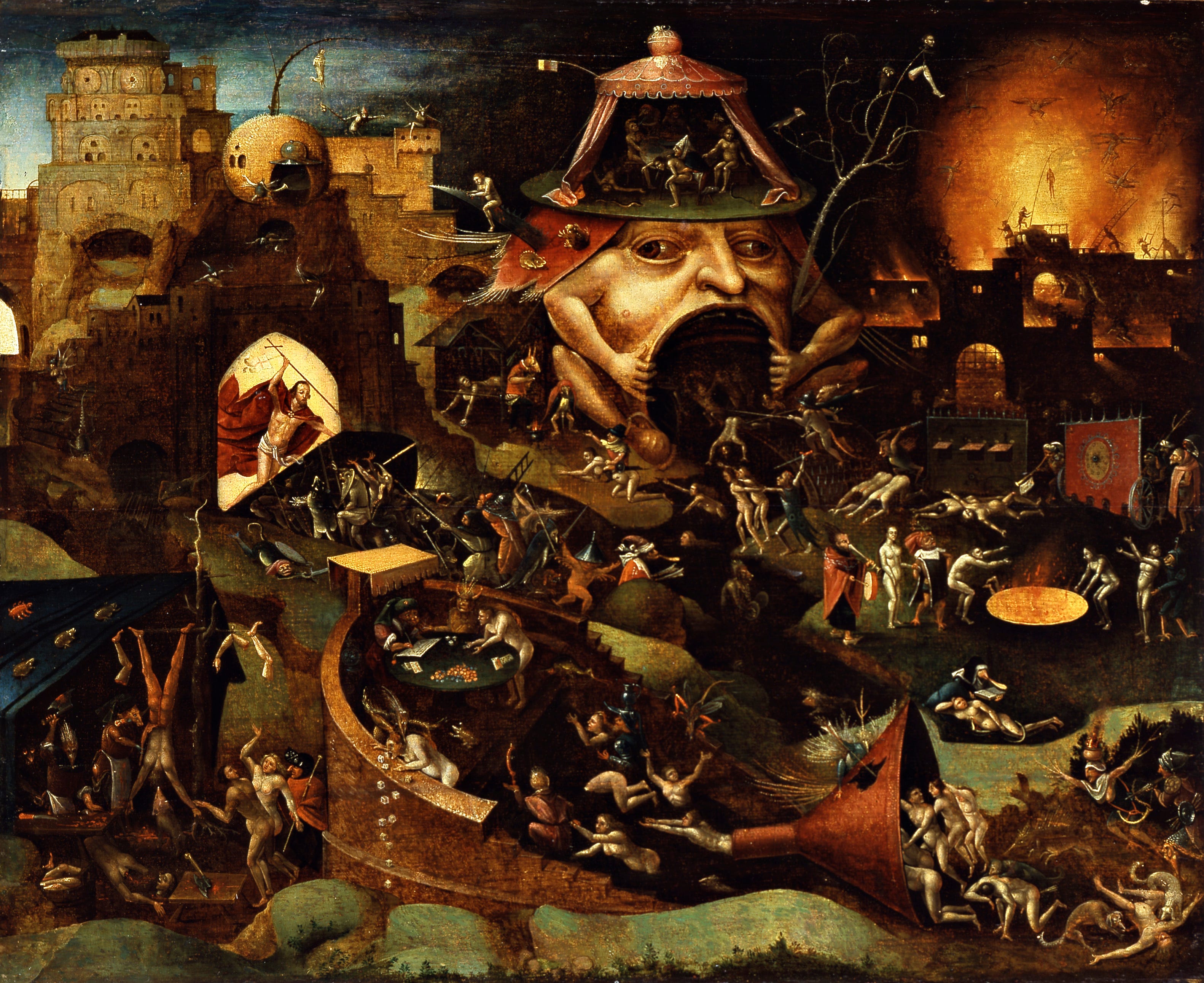
Suddenly, my vision went black. I stopped laughing. My unconscious rewarded this dialogue with the gods with an equal and opposite reaction. Behind my closed eyelids arose a series of images. Each image would have fit in the Hieronymus Bosch painting at the top of this essay, a painting I went back to after this session with renewed admiration for Bosch’s willingness to bend his gaze inward and “go there.” Each image in my mind rose from the blackness. Each paused in the liminal space between eyelid and eye. Each was testing me.
I read about this fascinating breakthrough after the fact. It has been spoken of with reverence by thinkers and meditators for millennia. Some meditations are designed to help us endure pain through mental toughness; others are to unlock the door to the crypt of our unconscious. It is like graduating from midnight raids with stone-tipped spears to dog fights with jets, and doing so in thirty minutes rather than twenty thousand years. The unconscious wants to bury our painful memories, thoughts, and fears, in order to protect us from ourselves. It does this to save us pain. As with physical growth, so with spiritual—the path to healing is the path of pain. Knowing thyself is a painful process.
The guru, YouTube, and Claude do not earn revenue when we smile into this pain, but when we bury it—and thus ourselves. What would Seneca say? “Men do not allow anyone to take possession of their estates, and, if there is the slightest dispute about the limit of their property, they rush to pick up stones and weapons: but they allow others to make inroads into their life, even extending personal invitations to those who will one day possess it.”
Ascetics and wise men retreat to caves and monasteries for self-knowledge and self-rule. But it is possible to achieve the same outcome without retreating and giving up a single inch. A No here, a Yes there. I only had the one Boschian session last week. But oddly enough, I find myself looking forward to another, and with immense curiosity.
5. Sketching nature for freedom
In the course of the day there are times when I merely see a flower because I am so focused on getting something done. It feels urgent and critical. But if I stop, forcefully, and reclaim my time with a bit of rebellion, I see six vanilla-white petals rimmed with pink, six lemon-yellow anthers with nearly translucent filaments, and a center pillar tipped with manilla. It is an eruption of awe and stillness in a world dedicated to destroying both. The urgent abstract constructs in my mind are replaced by the calming concretes of nature.
When I turn my mind back to the urgent tasks I can see them with the same granular clarity as the flower. It is even possible to see some beauty in them. Unworded impulses, churning desires, creeping concerns, irritating technologies—play things we can turn into meaning.
6. A rough sketch of an answer
What, then, is left but to turn curiosity into a craft? A discipline? Neither the passive-curiosity of modernity nor the forced-curiosity of the past, but a choice—a sovereign, rebellious, and explosively alive form of curiosity.
What then? is a passion project.
If you find these thoughts valuable, please support in whatever way seems best to you.
Can’t wait to start seeing targeted ads for “BLOOD CACAO!”
Great stuff, Sam. Onward on the journey!
Great insights. I call it insatiable curiosity and it's the first part in my trifecta of polymathic thinking
1. Insatiable curiosity
2. Humility
3. Intentional reframing to see if I understand it fully.
The final elemt you hit on is critical: targeted irreverence. This challenges our own and others self righteousness and is a key function of Stoicism that Andrew Perlot has written about.
Wonderful reminder.