

On Gandalf, Good News, and Alive Eyes
Living for a good fight

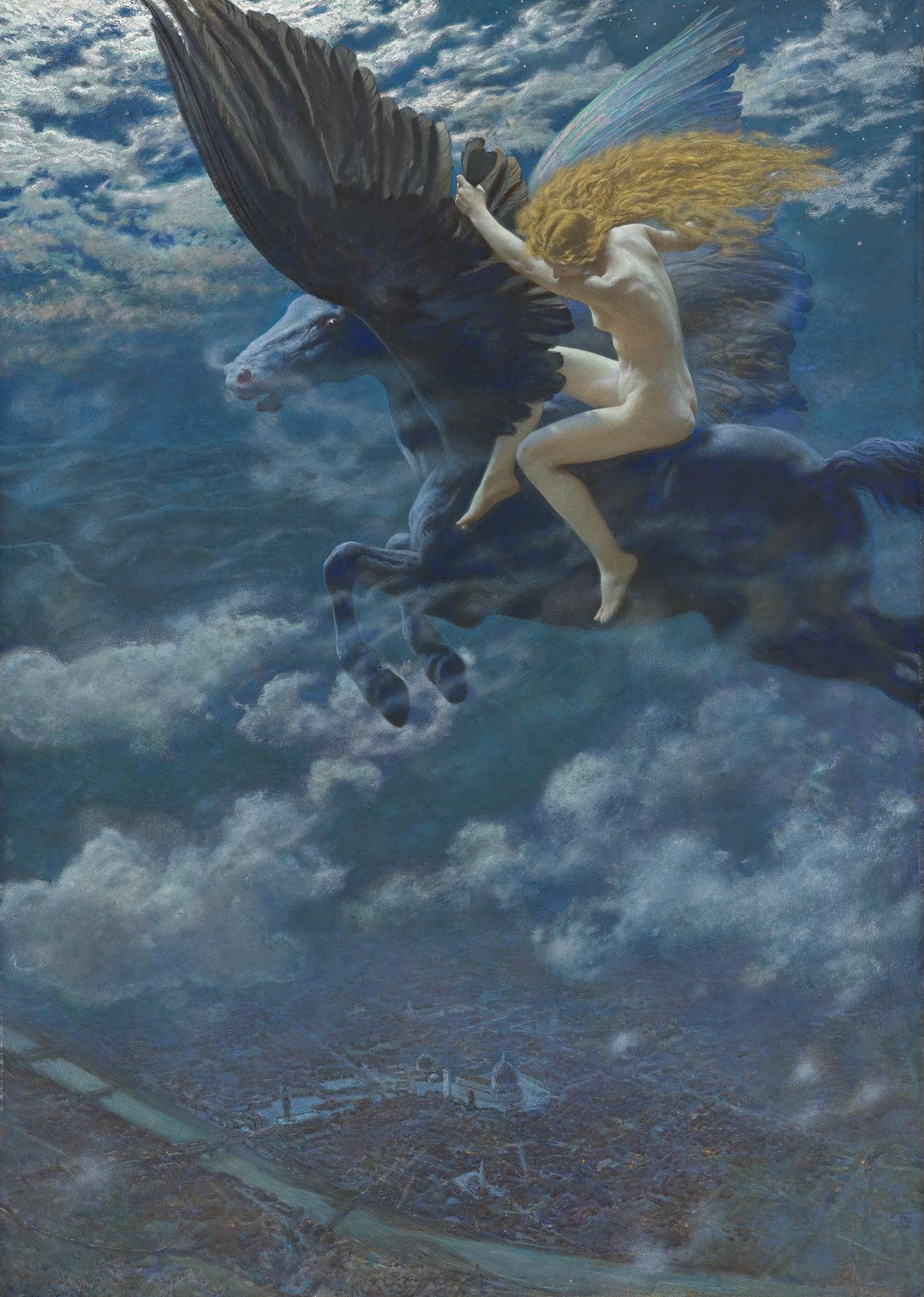
These three essays are completely unrelated in subject, and yet I was struck to find a common theme connecting all three. I write a great deal for myself in the form of short essays to flesh out ideas. I usually take one of these ideas and turn it into a longer essay. I’m going to experiment with dropping my smaller aphoristic essays here every now and then. Hopefully these are as striking as the longer pieces. Enjoy. —Sam

Where is all the good news?—My hunch is good news networks fail because they suck the life out of us. They are deenergizing. In the words of psychologist Rollo May, good news is like “putting someone into a canoe and pushing him out into the Atlantic towards England with the cheery comment, ‘The sky’s the limit.’” We are energized by bad news. Life-threatening events and promises of dystopia destabilize us, put our back against the wall, and brighten our eyes. We enter myth-making territory.
All this evil-mongering on the media is a rupture, a rebellion against lives too far removed from tasks of consequence. The subconscious motive is the unworded hope that democracy is really about to end; that Judgment Day is at last coming unto earth. We see non-events turned into apocalyptic horrors. We see a love of zombie movies and we can see ourselves with shotguns and a tribe: every step we take, every decision we make, and every battle by moonlight is met with ingenuity, a sense of usefulness, and clarity of purpose. I believe this is healthy. It becomes unhealthy when the sufferer does not know how to reconcile a lack of fights with a deep-seated love of fights—and they invent new fights.
Apocalypticizing is when we secretly wish bad news will turn into bad events for therapeutic reasons. Alas for the rest of us—a hundredth of 28 Days Later made real is enough to set civilization back 30,000 years. What if our sufferers no longer allowed themselves to be shaped by the intellectual degenerates who write our cultural discourse? What if they decided to define their own fight—one that did not require the death but the rebirth of civilization? What if our non-sufferers saw this ironic self-destruction as what it is—yet another epic fight to train for? It is no more than a means to sprint hills, build a tribe, study the past, and above all, enjoy the spectacle.
Gandalf is my spirit animal—I have read the Lord of the Rings every year since I was fourteen. It only gets better as I get older and my respect for Tolkien’s genius grows. I memorized the dialogue below. I believe it is a contender for the greatest quote in the history of literature.
Denethor, the steward of Gondor, said to Gandalf: “… there is no purpose higher in the world as it now stands than the good of Gondor; and the rule of Gondor, my lord, is mine and no other man’s, unless the king should come again.” And Gandalf replied with these immortal words: ‘Unless the king should come again?’ said Gandalf. ‘Well, my lord Steward, it is your task to keep some kingdom still against that event, which few now look to see. In that task you shall have all the aid you are pleased to ask for. But I will say this: the rule of no realm is mine, neither of Gondor nor any other, great or small. But all worthy things that are in peril as the world now stands, those are my care. And for my part, I shall not wholly fail of my task, though Gondor should perish, if anything passes through this night that can still grow fair or bear fruit and flower again in days to come. For I also am a steward. Did you not know?’”
For I also am a steward.
We have two types of steward here. The Denethor-steward looks after his city walls, his duty, his people. His is a micro view and a micro task. His staggering love of this micro task is his weakness: the moment his task is no more, he can be broken and never again add value where it is needed. He cannot see the good in all things that live and breathe. The Gandalf-steward does not look after a city but the Good. His is a macro view. He is willing to fight up to the end, even if the last thing on earth is a single blade of grass or his capacity to say No in the face of a blood-red sky and demonic fallen angels like Sauron bearing down upon him. His intensely vulnerable love for Hobbit and Elf, horse and eagle, simbelmynë and pipe-weed, is his strength. Everything is infused with vital energy and life-force. His last act in life can be one of pivotal meaning, whether beneath the glorious gates of Gondor or alone in a ditch in a desolate field.
Denethor-steward walks around Gondor and says “Gondor! Gondor! Gondor!” Gandalf-steward walks around Middle Earth and says “Elves, Men, Balrogs, Hobbits, mountains, fireworks, an inn with ale after many weary miles—a good fight!”
We can read the unwritten in human eyes—On a recent trip I ran into a friend I had not seen for almost twenty years. His eyes were radically alive, the sort of eyes that rarely exist outside of small tribes engaged in tasks of mortal consequence. The wrinkles round the edges only enhance the sense of penetrating perceptiveness. You can see the calculations grinding behind the irises. Through these many-hued windows and within the self-contained borders of the skull can be seen a galaxy of autonomous human judgement and vitality. Eyes reveal the boundaries of the spectrum we choose to inhabit: love and hate versus apathy; thought versus indifference; passion versus numbness; meaning versus nihilism. They show the choice between our awareness of the stunning gift that is life or our loathing of life because we loath ourselves.
Van Gogh had a great sentence on eyes: “I prefer painting people’s eyes to cathedrals, for there is something in the eyes that is not in the cathedral, however solemn and imposing the latter may be—a human soul, be it that of a poor beggar or of a streetwalker, is most interesting to me.”
Our eyes are as much for seeing the world as they are for showing others what we choose to see.
If you find these essays striking and want to support my mission, please consider sharing and subscribing.
I love this view, it's radically different from what we usually read, hear and see about the topic of "bad news"! I find myself agreeing to both, though. Bad news can drain people and leave them tired, empty and anxious. But that is only if they do not see the fight, the control, the choices they themselves possess! That's where your views come in, of the good fight, the primal hardship. Adopting that mindset, seeing one's own power over oneself and one's immense potential can turn the anxiety into confidence, fear into courage!
I do love a brief pithy well-written piece. Get in, say your bit, get out. Please keep sharing your short takes, Sam!
Your piece on Gandalf is sublime. The “Steward” is my preferred archetype of the good person on Earth. The person who truly lives the paradigm of NAMASTE (the spirit in me bows to the spirit in you) as you say so well with “His intensely vulnerable love for Hobbit and Elf, horse and eagle, simbelmynë and pipe-weed, is his strength. Everything is infused with vital energy and life-force.” Treating every living being as a THOU rather than an IT/thing for consumption (as embodied in the character of Sauron ) is the only route to salvation.