

If America Will Make It Another 250 Years, It Must Remember How To Suffer
Frogmen, modern meaninglessness, and extraordinary aliveness.

Thinker. SEAL. Dispatches on meaning and hardship. Also figs and dogs.
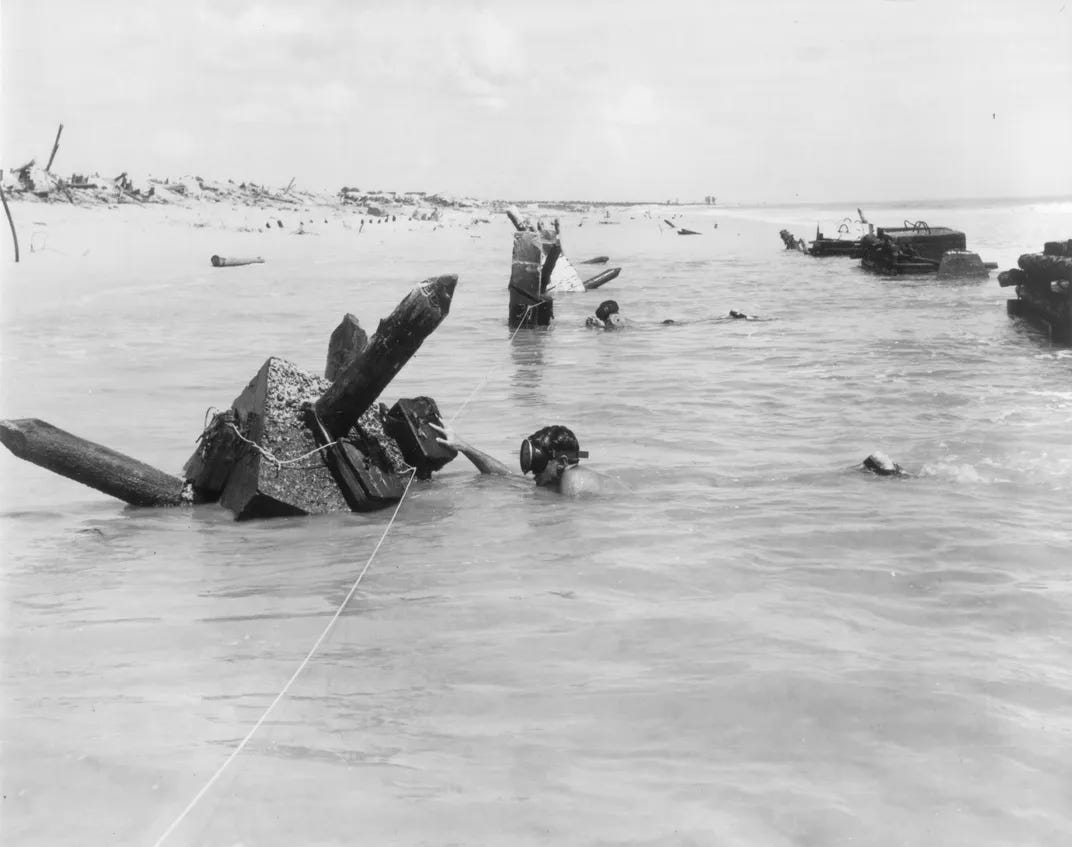
Much of my writing is spent critiquing modern civilization. This comes with the risk of seeming as though I do not think much of America. Nothing could be further from the truth. I see no other path to merge the best of the ancient world with the wonders of the modern without America. The reason is simple: only traditional American values give us the freedom to walk the “third path” I am circling with these essays. This piece is an ode to that freedom, and to America.
In the words of the longshoreman philosopher Eric Hoffer “Often, that which strikes us as the defeat of hope is actually its fulfillment.”
His words ring true at present.

Freddie the frog was the symbol of the Underwater Demolition Teams, which were the precursors of the Navy SEAL Teams.

It is striking how our symbols are a reflection of our culture’s values. Take Freddie. He does not give a damn. He is not wearing his dixie cup hat according to Navy regulations. He does not appear to care if he gets gum cancer. He is holding a stick of dynamite with a burning fuse in his right hand. On top of all of that, he is grinning. Every fiber of Freddie’s being is devoted to a single noble, life-affirming mission. Freddie is so devoted to this mission he is willing to slip on a pair of flippers, strap a knife to his calf, paint his face blue, grab a few limpet mines, and swim through a steel storm of enemy bullets and whistling mortars to blow their beach obstacles to hell, risking a lonely, watery death.
During World War II, Frogmen who survived their missions in the surf zone were picked up in an ingenious way. They would swim back out to sea, spread out, and tread water in a line parallel to the beach. Black boats would get a running start, then drive at full speed along this line, often under immense enemy rifle and mortar fire. Someone in the boat would hold a rubber tire tube over the side. One Frogman at a time would hook his arm into the tire, get torn from the water, and land with a crash on the floor. It is not a comfortable feeling.
One man who was responsible for slinging Frogmen into his boat recalled a standard mission: “We got them back aboard, and they would be out on the mission for 72 hours without sleep. That was a group of men that I had a healthy respect for; just the way they carried themselves, and their ability—everything about them, they were having fun… You are not alive, unless you are living on the edge. Living on the edge like these swimmers and the rest of those men, you are alive. I mean, you are alive.”1
My sense is this “aliveness” cuts close to the core of America’s problem at present. Freddie had a chaotic and violent war; this war led to tribe, purpose, and immense aliveness; and all of this let him see the good in his country, his countrymen, and the values they stood for. Freddie was simply a reflection of an America with its back against the wall—an America filled with purpose and identity.
It is significant Freddies are born of hard times. They crawl out of the metal carnage of World Wars. Freddies are less likely to be found in easy times. But what is unique about America is how many Freddies exist at any given time—how alive many Americans are. They exist in working class neighborhoods, farms in the middle of nowhere, or as individuals who simply like to hold their own counsel. In a more warlike form, they exist in tiny pockets in the military, operating on the margins, training… waiting to be called on.
But America is a land of extremes, and its pendulum therefore swings with greater force. It is worth asking what Freddie would look like if he were drawn today? Depending on which segment of our culture we are talking about, Freddie might wear that vacant smile and disturbingly detached expression of those who look down at their social media feeds while walking, driving down the highway, or standing in the middle of a parking lot. Or he might have perfectly chiseled muscles and six percent body fat in his attempt to live to 120, and yet like so many in his generation, have zero sex (one of the best essays I have read on this subject is Everyone Is Beautiful and No One Is Horny). Or he might look like a Call of Duty video game version of an Operator with a rainbow-colored AK-47 and Master Wizard status. Or he might be made middle aged and wear a face mask, rubber gloves, and a Hello Kitty back pack while walking into Whole Foods.
On a less satirical note, he might have an anxiety disorder when he has never taken a risk in his life. Or he might suffer from loneliness because safety does not demand we build a tribe to survive till sunrise. Or above all, he might feel a profound sense of meaninglessness because he is told his country is evil, his culture is toxic, he is a fool, and none of it is worth fighting for.
The problems are becoming clear to everyone: an unprecedented amount of thought-terminating short-form entertainment, free time, safety, ease, boredom, and affluence. Said negatively, it is an unprecedented lack of exposure to just how wretched life can actually be. It is, ultimately, due to a lack of mortal necessity.
The intention of all those Freddies in the past was to end the existential threats to America. This they did. But in an astounding reversal, they created an existential crisis of meaning and identity under the burden of freedom—freedom from necessity, meaning, and having to do something that matters in one’s life. The ancient question of “How do I live?” has slowly been replaced by a more haunting question: “Why do I live?”
This does not bode well for our age, for true trials lie in the near future.
America in her 250th year is at risk.
I am not referring to Chinese propaganda, terror cells, blacked-out boats filled with fentanyl or illegal immigrants, greedy corporations, tech companies, or even politicians. The only threat that can destroy America is from within, on an individual basis: those broken by ease, privilege, boredom, unearned guilt, lack of tribe, radicalized social movements, social media, or reckless hatred. In sum, those who allow themselves to be swayed ideologically by others, chain themselves to whatever random faction they can cling to like a life raft, who choose not to stoke their own “aliveness,” and instead hope to find it by undermining the aliveness of those who have learned to make the most of freedom.
Of course, all this assumes America is actually worth saving. What, then, is America? What else, if not the place where we can Make Politics Boring Again? Where we can live alone in a cabin in Michigan to paint, live amid millions in New York City to do stand-up comedy, or live anywhere and make spoons and forks out of old railway ties and sell them on Etsy? The place where we can make a fortune? Where we can make a fortune and die of a heart attack? Where we can make a fortune and give it all away? Where we can spend days walking on conserved land in National Parks? Start a yoga retreat? Laugh at a long series of unserious politicians? It is all of these things. It is where we are free to make of our own individual lives a heaven or a hell.
In an earlier war, WWI, Pierre Teilhard de Chardin was a French Jesuit preacher, paleontologist, and soldier who observed the Americans sent to help. He wrote, “We had the Americans as neighbors, and I had a close-up view of them. Everyone says the same: they’re first-rate troops, fighting with intense individual passion… and with wonderful courage. The only complaint one would make about them is that they don’t take sufficient care; they’re too apt to get themselves killed. When they’re wounded, they make their way back holding themselves upright, almost stiff, impassive, and uncomplaining. I don’t think I’ve ever seen such pride and dignity in suffering.”2
This is probably not what a random observer would write about Americans living in their own country today.
What then can we do about all of this on America’s 250th?
I see three different paths.
On the first path, we find American pride and dignity—America at her best—when the innocent are suffering, our back is against the wall, and young American men with cigars and sticks of dynamite lie dead in the surf zone of foreign beaches. But this requires war and tremendous suffering.
On the second path, we find American misery and meaninglessness when the rhythm of life is governed not by one’s self, but by social media feeds, intellectuals, politicians, and apocalyptic levels of free time and self-rumination. This, too, if it continues long enough, will probably end with war and tremendous suffering.
But the third path is what makes America an anomaly in the history of civilization. It is to remember that America is not a place but an idea, an idea that can come to an end before midnight; that our back is still against the wall; that America is still exceptional and worth fighting for precisely because it gives us the option of defining our own mortal necessity in life, and stoking our own profound love of life.
The danger of the third path is, of course, that we can also choose not to make the most of this freedom. The life-negating cannot tolerate the life-affirming precisely because they remind them of the burden of choice America places on their shoulders—the simple choice of either self-realization or self-destruction. It follows that, like the Greeks, we can burn our own bridges in front of the Persians; that, like Cortez, we can burn our own ships in front of the Aztecs. We can double down on American love of life and American values with a renaissance of sorts. We can elevate, on an individual basis, above the collective voices eating away at the idea of America, and show what it is we can be and do in this novel experiment of freedom within the state: build a community, start a family, conserve land, write a haiku, invent a reusable spaceship, plant a peach orchard, fail, dream, live—the list is long for those who love life.
What follows? Let us make a prophecy. If the American experiment is to last another 250 years, it will only do so if we manage to bring back what Teilhard saw in the burning vineyards of France, and do so not by force, but by choice—create pride and dignity in suffering once again.
Like Freddie.
If you find value in these ideas, please support in whatever way you think is best: restack this essay, share it with others, or become a paid subscriber.
O’Donnell, Patrick K. Operatives, Spies, and Saboteurs: The Unknown Story of the Men and Women of World War II’s OSS. Free Press, 2004.
Teilhard de Chardin, Pierre. The Making of a Mind: Letters from a Soldier-Priest, 1914–1919. Translated by René Hague, Harper & Row, 1965.
Εἰς μελέτην
For meditation
As an outsider and non-American, I do think it's inspiring to read what you just wrote Sam! I do think a lot of things that are happening not only in America, but worldwide, are very questionable and frankly shocking at times, but to still see that the idea and the spirit behind the American dream is so alive in certain individuals, AND also expresses itself in so many unique ways, many of them absolutely beautiful and poetic! I hope too that the third way you proposed, or maybe even another amalgamation of other ideas finds its way through, we're all truly made for more than doomscrolling, dark crimes and meaninglessness.
Speaking of which, it's time for me to go to the gym and fight some dudes.