

How Dogs Keep Us Calm
A SEAL expression, the modern world, and phenomenological examinations of our mutts

Writer. Navy SEAL. Dispatches on meaning and hardship.
My core theory is the more civilization progresses, the greater its crisis of meaninglessness becomes. Here at “What then?” I riff on why this is the case and what we can do about it: live with intense attunement to nature, train for the worst case scenario, and many other paths.
But sometimes I just want to write about dogs.
Thus today’s essay bridges the two ideas I will spend the rest of my life thinking about: my core theory, and dogs.
On to it…

Once we left the trail we had to leash Carson, our mutt. Of course this meant I had to stop when he stopped every three and half feet to lift his leg, do a three stage sniff, and claim the mailbox or lily as his own. Time slowed as he carefully contemplated several blades of grass freshly dampened with urine. Ten seconds... twenty seconds... I tried not to rush him.
To a dog, smelling urine is the same as reading Dostoevsky, with all the immense attention such a complicated Russian artist deserves. To a human, the dog is merely smelling piss.
I wanted to keep moving my legs, but our canine’s slowness has something to teach us about the human condition—something significant.
We started walking again when suddenly the black-bottomed clouds were lit with white flame around their edges and a lightning bolt stabbed the earth a few miles in front of us. The roar rocked the air. I saw his ears plaster to the back of his head. He gave me the slightest glance out of the corner of his left eye and he suddenly started trotting towards home, Dostoevsky forgotten.
I saw this as a training opportunity. I spoke slowly to him, with a smile in my voice, and said “Good boy. Good boy. It’s all good. Lightning is fun, right?” His eyebrows squeezed together and rose in an expression that said “Oh, is it really good? Okay, I trust you. I’ll believe you if you say so.”
There is an expression in the SEAL teams that embraces an ancient world philosophy. It goes like this: “Calm breeds calms, excitement breeds excitement.” From a human perspective, calm means we are quietly free from disturbance. From a nautical perspective, calm means freedom from storms and rough seas that can kill us. The significant point is human calm does not rely on nautical calm—in fact, the exact opposite is often the case.
We are designed by nature to be quietly free from disturbance while in the middle of apocalyptic disturbance. Internal tranquility in external hell. It is to look down at panic-tinged excitement. It is to smile at it.
Let us ground this abstract idea in the seas somewhere off the coast of Oman. We see eight SEALs white knuckling a swinging medal ladder made of wire on the side of a hijacked cruise ship in a storm. With every surging wave, the roof of the fast boat speeding beneath them rises and threatens to smash the bones of their feet against the hull of the ship as they climb rung by rung. The terrorists with rifles who commandeered the ship may discover the men are climbing aboard. If they do, they can hold an AK-47 over the side and end their lives and their paltry rescue attempt with a single trigger squeeze on full automatic. Or they can sever the ladder and watch them drown in eighty pounds of gear.
Thus if a single man loses himself to excitement, jitters, or panic, the rest of the men might collectively pay for his sins with their lives. But if one of them is supremely calm—even as his fingers are ripping out of his hand and his mind’s eye can see that AK-47 barrel creeping over the edge of the ship above him with a leering bearded man behind it—his calm spreads like a healthy cancer through the chaos. Their inner observers relax in their skulls. They relax into the climb, no matter what may come.
So I felt good about myself when I calmed Carson.
And then when I thought about it later that night, all that goodness melted away when I was struck by a revelation: We humans only feel so good about protecting our quadrupedal kin on account of how rarely we calm them compared to how often they calm us, and for lesser matters than mere lightning. We feel like we are repaying them for once.
It seems, then, we calm the dog in a bit of lightning, yes, and maybe even a ship assault—all those apocalyptic disturbances of the ancient world we come explosively alive in—but the dog calms us amid what we were not designed to remain calm in: a million chronic, gnawing, and abstract modern threats.
We have built a culture free from storms at odds with the human condition. We institute cultures of calm when we train to overcome concrete threats as a way of life: men with AK-47s, seasonal monsoons, and the like. We fall victim to cultures of excitement when our threats are abstract, shapeshifting, and designed to exploit every mammalian impulse we possess: rushing rushing rushing timelines, a shoulder-tensed obsession with staying ahead of things, the breathless idea that “I will sacrifice my peace and self-mastery at present for my vision of future bliss and then I will be calm,” yet another back-stabbing asshole at work, bumper-to-bumper traffic, a scandalously asinine politician, four walls growing closer and closer together and eyes growing redder and redder behind liquid crystal displays late at night…
So our culture murders calm. I can hear Nature laughing as we try to unriddle the situation we humans have put ourselves in. The strange fact is it is the calm without apocalyptic disturbance we often find most difficult to bear. But the dog, one of the few anchors we have left to ancient simplicity, keeps us calm.
How?
Let us look at our dogs.
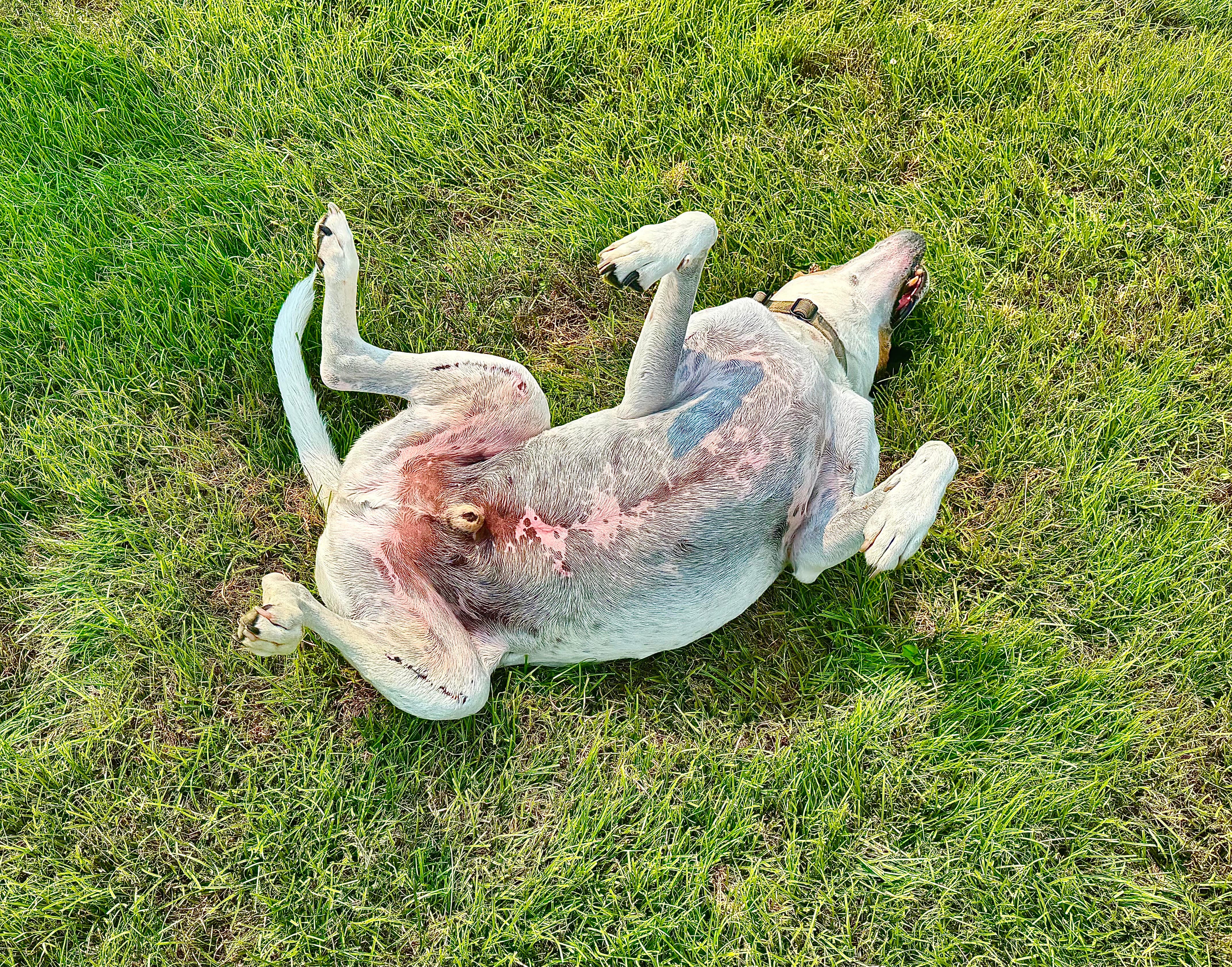
When I look at Carson laying on his side in corpse pose, or savasana as the Yogis like to say, this is what I see: his stomach is a pink sea with islands of black beneath wispy cirrus clouds of cotton white. The entire structure rises and falls with the rhythm of a seasonal cyclone. Dreaming, his tail goes thump thump thump, his glistening black lips twitch into snarls, and the fingers of his little hooves clench and unclench.
From one divine mutt, we can learn something of our culture, for the dog is a micro-culture, a canine-culture. This culture is one of inhales… and exhales… One of calm and a slower rhythm of life, mixed with savage bouts of zoomies. One with periods of total rest and contentment. One in which the gnawing voices in our skull wailing and gnashing their teeth for some future expectation or dream or object disappears, leaving us filled with the slow beauty of this exact second in time. A canine-culture shatters the illusions—and delusions—of our modern human-culture, so long as we slow down and take the time study it.
The dog is telling us it is all good; that we can institute a culture of calm once again.
We should believe them if they say so.
Εἰς μελέτην
For meditation
I've been struggling during exam phase recently, and that's also spoke to me in your essay. Of course I don't have combat experience so I cannot possibly assume things like that, but I feel I'd adjust to such a physical life-or-death situation better than I do to anxiety and depression. It's at least something to grasp onto, to see with your own eyes. But then again it's no excuse right? And at that point I'd also say that it's worth seeing if "calm breeds calm" works in an inner-directed way with oneself as well! Guess I'll try, it's better than nothing!